




Clément Lambert
Associate Professor Paleoclimatology
Skills
Climate change
Environment quality
Micropaleonlotogy
Paleoclimates / Paleoenvironments
Palynology
Sedimentology
About
After a Ph.D. thesis focused on understanding the mechanisms and regional responses to climate variability, Clément Lambert works on the climate and environmental aspects of global change at different time scales. Concerning the "long-term" variability, the study period is the Quaternary, more precisely the Holocene, the interglacial period that began 11,700 years ago. Fossilized organisms resting in sediment (pollen and planktonic microalgae) during this period allow us to reconstruct climatic and environmental variations.
Regarding the recent period, the same tool allows the study of the evolution of littoral environmental quality, including pollution, eutrophication, and modifications of the physical and chemical properties of water. The comparison on this scale enables a discussion on human influence.
In coastal environments, the vulnerability of human societies to climatic hazards is particularly high, and anthropogenic pressures on ecosystems are increasingly strong. In this context, facing the dynamic occupation of territory by humankind, which is more pronounced, he also takes an interest in the relationship between society, climate, and the environment over time.
Interview : paléoclimatologue
WHAT IS YOUR CAREER PATH
J’ai commencé par une Licence en sciences de la terre et de l'environnement à l'Université de Bordeaux. J’ai continué avec un Master recherche en Océanographie et je me suis spécialisé en sédimentologie et paléoclimatologie. J’ai ensuite réalisé une thèse de Doctorat à Brest, à l’IUEM (Institut Universitaire Européen de la Mer), dont l'objet était la reconstitution de 10 000 ans d’évolution climatique et environnementale en Bretagne. Je me suis attaché a comprendre la réponse environnementale régionale face aux changements climatiques globaux, les causes de ces évolutions et les liens avec les sociétés humaines dans l’histoire.
WHY DID YOU WANT TO BECOME AN ASSOCIATE PROFESSOR IN PALEOCLIMATOLOGY ?
C’est une découverte en Licence et en Master. Mon cursus universitaire m'a permis de découvrir les géosciences et les sciences du climat. Je souhaitais exercer une profession en rapport étroit avec la nature et l'idée de reconstituer son évolution passée me fascinait. Lors de mon stage en laboratoire de recherche pendant ma deuxième année de Master, j'ai su que la profession de chercheur était celle que je voulais exercer. Ce métier me donne la possibilité de m'interroger sur le fonctionnement du monde dans lequel nous vivons et d'essayer d'apporter des réponses aux questions que je me pose.
Teaching is also a pleasure, it's interesting and allows me to see something other than research. I believe that it is sometimes necessary to step out of the laboratories, that we have a significant role to play in sharing knowledge about climate change and environmental perturbation.
DOES A BETTER UNDERSTANDING OF PAST CLIMATE VARIATIONS HELP TO BETTER UNDERSTAND THE CURRENT ONES ?
Indeed, understanding the causes of past variations allows us to deepen our knowledge of the functioning of the climate system with a wider vision. Reconstructing the environmental impacts of past climate variations may eventually help envision the future consequences of climate change. Moreover, climate models that attempt to predict future climate variations are calibrated based on what we know about past climate variations.
ON WHAT TIME SCALE DO YOU WORK?
Lors de ma thèse j’ai travaillé sur les 10 000 dernières années. Je m'intéresse à certains microfossiles présents dans les sédiments (microalgues, grains de pollen…) pour reconstituer la variabilité climatique et environnementale passée. Il est possible de travailler sur différentes échelles de temps à partir de ces mêmes outils (des derniers milliers d'années aux périodes beaucoup plus récentes comme les derniers siècles voire décennies). Toutes ces reconstitutions permettent de mieux comprendre l'impact de nos activités sur la qualité des environnements.
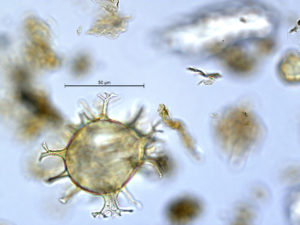
Kyste de dinoflagellé (une micro-algue phytoplanctonique) dont le nom d'espèce est Spiniferites bentorii. (Photo prise au microscope optique).
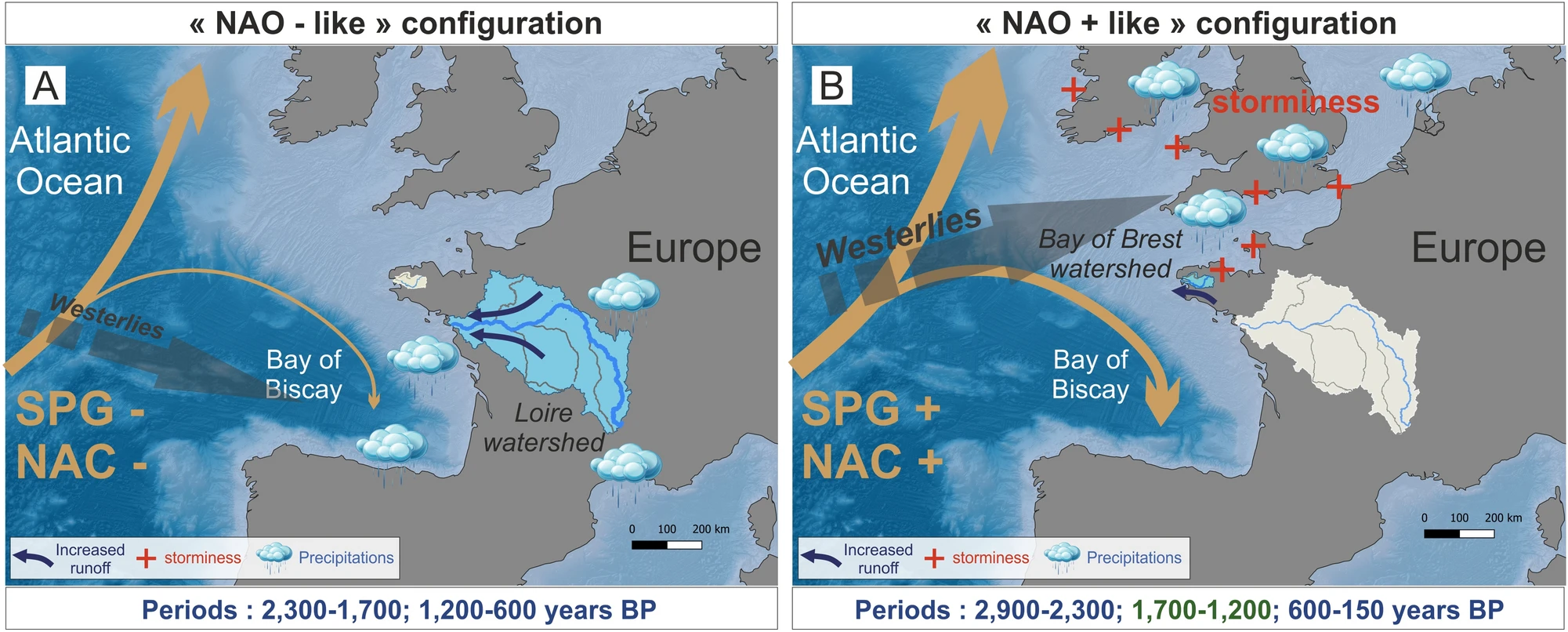
Modèles conceptuels schématiques montrant la position des trajectoires des tempêtes, du Courant Nord-Atlantique (NAC) et du gyre Subpolaire (SPG) pendant les intervalles pluriséculaires (A) "NAO + like" et (B) "NAO- like" et l'influence associée sur les tempêtes et les modèles de précipitations sur l'Europe du Nord-Ouest. Les bassins versants en bleu représentent une augmentation des précipitations et du ruissellement. La carte a été créée à l'aide du logiciel QGIS version 3.4.5 (https://www.qgis.org).
Thalassa Report - "Morbihan : Un archipel en Bretagne"
April 10th 2019
https://fb.watch/EPffM4Ltw0/